
Similar questions:
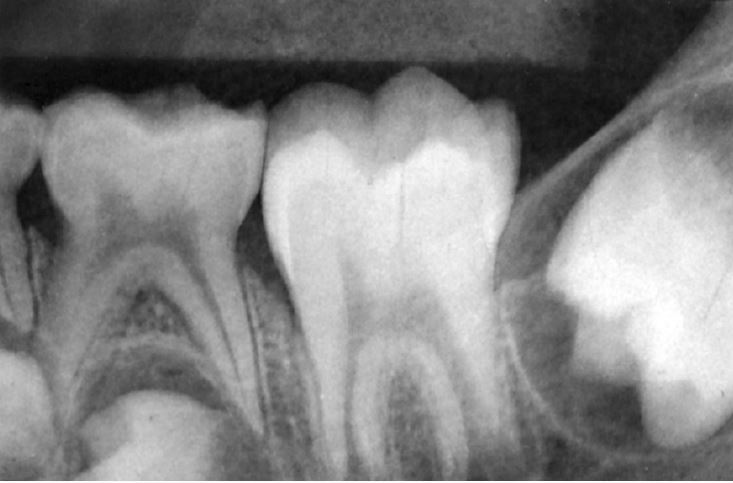
The discontinuity of the lamina dura on a radiograph may be a consequence of
1. pulpitis.
2. metastatic carcinoma.
3. parathyroid hyperplasia.
4. eburnated bone.
(1) (2) (3)
NDEB released questions set 2
A radiolucent area in a radiograph occurs as a result of
1. decreased density of tissue.
2. increased density of tissue.
3. more radiation affecting the silver halide crystals.
4. increased exposure time.
(1) and (3)
NDEB released questions set 2
A radiograph reveals a radiolucency associated with the apex of tooth 1.5. There is a large restoration but the tooth is asymptomatic and the associated soft tissues appear normal. What is the most likely diagnosis?
Chronic periradicular periodontitis.NDEB released questions part 2 set 1
The initial histological appearance of a successful apicectomy would show on a radiograph as
a radiolucent areaNDEB released questions part 2 set 4
A radiographic term used to describe the dense bone image of the socket and septal crest is
lamina dura.NDEB released questions part 2 set 7
A 7-year old child who complains of pain when eating, has a large carious lesion on a permanent molar. A radiograph reveals no periapical change. Your treatment is
indirect pulp cappingNDEB released questions part 2 set 7
When a radiographic examination is warranted for a 10 year old child, the most effective way to decrease radiation exposure is to
use a thyroid collar and lead apronNDEB released questions part 2 set 10
When a radiographic examination is warranted for a 10-year old child, the most effective way to decrease radiation exposure is to
use a thyroid collar and lead apronNDEB released questions part 2 set 13
A radiographic examination of a 10 year old child reveals retention of deciduous teeth and presence of many unerupted supernumerary teeth. This is characteristic of
cleidocranial dysplasiaNDEB released questions part 2 set 15
Which of the following can be mistaken on a radiograph for a chronic alveolar abscess?
All of the above.NDEB released questions set 3
A radiographic examination of a 10 year old child reveals retention of deciduous teeth and presence of many unerupted supernumerary teeth. This is characteristic of
cleidocranial dysplasia.NDEB released questions set 4
In health, the crest of the alveolar bone, as seen in a radiograph, is situated 1~to~2mm apical to the cemento-enamel junction. .sp 1 Radiographically, the normal alveolar crest should parallel an imaginary line drawn between the cemento-enamel junction of adjacent teeth
Both statements are true.NDEB released questions set 4
A patient who is four months pregnant requires an extraction. A radiograph may
be takenNDEB released questions set 7
A fistula found in association with a non-vital tooth should be
1. cauterized to remove the epithelium.
2. traced to source with a gutta-percha point on a radiograph.
3. treated with combined surgical and nonsurgical root canal therapy.
4. treated with nonsurgical root canal therapy.
(2) and (4)
NDEB released questions set 9
When a radiographic examination is warranted for a 10 year old child, the most effective way to decrease radiation exposure is to
use a thyroid collar and lead apronNDEB released questions set 11
0 explanations
Explanations are useful to guide through learning process and confirm that the correct answer is indeed correct.
Only registered users can add explanations